
About Me

My photo
I'm a busy Mum and a Biomedical Scientist in Haematology. My particular interest is in blood cell morphology and parasitology, where I never stop learning.
Showing posts with label Blood Cell. Show all posts

Saturday, 19 February 2022

blood film diagnosis- it's all about texture, colour and shape!


Recognising an acute leukaemia heavily depends on your ability to make the distinction between different textures, colours and shapes!

Take a look at this photo of a blast cell (upper left) seen in an Acute Myeloid Leukaemia and a mature neutrophil (cell that looks like a happy face, bottom right). Notice the nucleus. The blast cell has chromatin in the nucleus that is very spread out, almost looks as if dots have been made with a fine pen. Compare this to the neutrophil. The chromatin in the nucleus have condensed, showing lots of texture. To me it almost looks like knots!


Blasts often have spherical inclusion in the nucleus called a nucleolus, which can be seen on the cell above over to the left side. This also tells us we are looking at an immature cell.

Scientists use this along with features such as size of cell and size of nucleus compared to cytoplasm,  in order to recognise an immature cell. 

From there we need to take this further and distinguish which type of Acute Leukaemia we could be dealing with and again this about recognising subtle features. Look at this picture. The little red ‘comma’ like inclusion in the cytoplasm is called an auer rod. This tells us that this is an Acute Myeloid as opposed to an Acute Lymphoid Leukaemia.


To go further it is possible morphologically to determine more about the type of Acute Myeloid Leukaemia we are dealing with, by looking at shapes and colours and this leads me onto today’s film which my colleague very kindly saved for me . It’s an Acute Promyelocytic Leukaemia (APL). It is vital that the distinctive morphology is not missed as APL is a haematological emergency.

 There are two types of APL, one has abnormal promyelocytes with numerous granules, whilst the other which we have here is the variant form and the blasts have distinctive bilobed nuclei and appear to lack granules. The morphology of the variant is quite distinctive and should always be on the Scientist's mind when assessing a blood film for a new leukaemia.
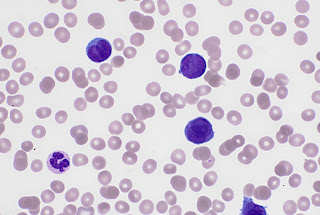


APL is a haematological emergency as it can be rapidly fatal due to bleeding and thrombotic complications. This patient indeed had a D-Dimer result of 2560 ng/ml. Suggestive of DIC. In DIC clotting factors are abnormally consumed which leads to not only bleeding but also thrombotic issues. Bleeding into the brain or lungs or clots blocking the heart, brain and  lungs can be life threatening.

I’ve been reading an article that explains APL quite nicely at https://rarediseases.org/rare-diseases/acute-promyelocytic-leukemia.

I didn’t know the actual reason behind the coagulation issues in APL but it appears that on the surface of the abnormal promyelocytes is tissue factor which contributes to the activation of the clotting cascade. Also Annexin II, present on the surface of the promyelocytes activates plasmin which breaks down blood clots. The activation of these two leads to excessive clotting, excessive bleeding and excessive breaking down of clots.

The treatment for this type of leukaemia uses a derivative of vitamin A which matures the promyelocytes to mature neutrophils! This treatment is called al-trans-retinoic acid or ATRA.  This is because most patient’s with APL, alterations in the RARA gene occur, which is involved in using vitamin A to mature blood cells. The alteration to the gene occurs where the RARA and PML genes are located leading to the PML/RARA fusion gene. This leads to abnormal vitamin A and stops maturation of the promyelocytes, leaving them in effect ..stuck! Pretty clever treatment based on understanding the role of the RARA gene.

The ability to recognise differences in texture, colour, shape and size of blood cells forms the basis of blood cell morphology . This is vital in the rapid diagnosis and treatment of APL because quick treatment with a vitamin A derivative is required to mature the abnormal promyelocytes and therefore lessen the coagulopathy.


Wednesday, 13 October 2021

A Medical Emergency

A case here that I wasn’t expecting to see on a recent weekend late shift, but a condition that is a medical emergency and fatal without the appropriate treatment, Thrombotic Thrombocytopenic Pupura or TTP for short.

This is a rare condition, and therefore even more important to keep in the forefront of the scientist’s mind when reviewing blood results. 

This patient attended Accident and Emergency, very unwell with a rash. The platelet count was 4 x10^9/l. The blood film was classic, severe thrombocytopenia with numerous fragments of red cells. This picture is consistent with  microangiopathic haemolysis.
Other significant markers are a raised bilirubin, LDH, Reticulocyte count , all markers of haemolysis and a raised creatinine, indicative of renal damage.

 
In this condition, clots are forming in blood vessels throughout the body, blocking oxygen flow to the body’s organs including  the brain, kidneys and heart, leading to complications such as stroke, myocardial infarction and renal failure.

The platelet count was so low because the platelets are being used up as the clots are forming, which will result in bleeding internally and under the skin. The red cell fragments are caused by red cells squeezing past blood clots, which leads to anaemia and a progressively falling haemoglobin. 


 For Scientists the action should involve

1. looking under the microcscope immediately on any new low platelet count. 

2. Note whether the haemoglobin is dropping aswell. 

3. The presence of red cell fragments, polychromasia and thrombocytopenia on a blood film is highly suggestive of a microangiopathic haemolytic anaemia which includes TTP and HUS. DIC also gives a similar picture. 

NOTE: even the very occasional red cell fragment is enough to consider this condition.

4. Add haemolysis markers on. We added a reticulocyte count, bilirubin and LDH. 

5.Phone the Consultant Haematologist and clinician immediately with all the relevant             information.

6. Further tedts of use are ADAMST13, Haptoglobin, clotting screen and D-Dimer.

The condition is caused by a lack of an enzyme called ADAMST13 that breaks down a clotting protein, Von Willebrand factor. This patient was indeed very deficient in ADAMST13. The cause of this to happen in this patient is unknown, but something had triggered the body to make antibodies against ADAMST13. A virus perhaps. In a separate case I was involved in a few years ago, a drinking binge in a young adult, triggered TTP!
The treatment for TTP is to exchange the plasma, giving back the ADAMST13 enzyme, which is a life saving treatment. Very sadly this patient didn't survive long enough to receive this treatment.

 This is a medical emergency with often only hours before life threatening and fatal complications occur, which unfortunately was the outcome in this case.

Sunday, 4 October 2020

Digital Morphology 2004DM 04/10/20

Digital Morphology 2004DM CPD date 04/10/20 

 I got this right! Myeloproliferative disorder transformed to Acute Megakaryoblastic Leukaemia. 

 I love the training links on the UK NEQAS digital morphology website. Take a look https://www.instagram.com/haematography/, really useful for anyone involved in blood cell morphology.

 I particularly found useful, the guidance on when to use the term 'Megakaryocyte fragment' and when to use the term 'Giant platelet'. Megakaryocyte fragments are basophilic, often atypical in shape, may be vacuolated and lack granules. A giant platelet however is enlarged but has very typical platelet features.
Another learning point from the case narrative was that the heavy granulation (what I would call toxic granulation) in this case, may not neccessarily be due to infection or inflammation, but yet another bizarre abnormaility. A point that I had not previously considered. 

 The narrative also mentions that the fragments seen are not associated with with an acute microangiopathic haemolytic anaemia (MAHA), as they are note sharp in appearance. The bizarre shaped fragments seen here are found in Dyserythropoiesis. I have personally however, seen blunt red cell fragments in TTP but I accept the bizarre shapes are not a feature of MAHA.
Lots of learning points on this film.