
The paper states that the major parameters are mostly independent of factors
such as gender and age and patient population and therefore are very useful in
XBarM monitoring. These include the MCHC and Sensitivity parameters. They also
are involved in two technical units of the XN analysers, the FCM detector and
RBC/platelet detector and HGB detector.
 MCHC
MCHC

The MCHC only varies naturally within a tight range as it is calculated from the
HGB and HCT and abnormal results for the MCHC are usually related to sample
quality issues or analyser failure, rather than clinical reasons. The clinical
reasons I can think of are slightly raised MCHC can be seen when spherocytes are
present in haemolysis and low value can been seen when there is a microcytic,
hypochromic anaemia. On the XN series, the MCHC is two different technical
detectors, the RBC/PLT channel and haemoglobin channel are used and can
therefore be monitored at the same time.
Sensitivity Parameters
The sensitivity parameters again are useful in XbarM analysis as biologically
will not vary very much and will monitor the technical units used for flow
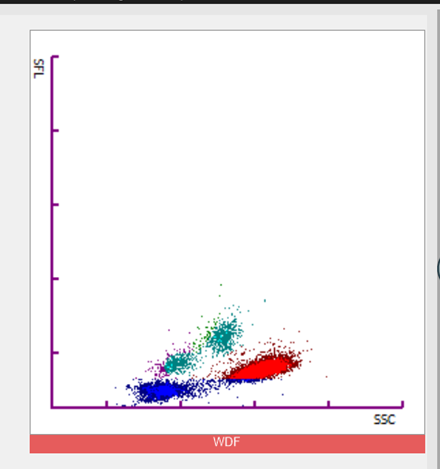
cytometry . They relate to the scattergrams that are produced in different
measurement channels and the position of the cell populations. For example below
the WDF-X and WDF-Y will mark the position of the neutrophil population on the
WDF scattergram and this shouldn’t vary significantly biologically.
 Supporting Parameters- Less useful
This group is not so important in XbarM analysis as they do have more biological
variation and do depend on the patient population . IQC is a better way of
monitoring these. These include MCH and MCV, WBC, RBC, PLTS, HGB and HCT.
Supporting Parameters- Less useful
This group is not so important in XbarM analysis as they do have more biological
variation and do depend on the patient population . IQC is a better way of
monitoring these. These include MCH and MCV, WBC, RBC, PLTS, HGB and HCT.

Other parameters- Waste of time!!!
These again are highly variable parameters that depend on patient population,
type of ward, season etc. These are therefore not useful in XbarM control
program. They mainly include the WBC differential and distribution parameters
such as RDW for example.
Those parameters that have a very narrow biological
range i.e MCHC and sensitivity parameters are very useful in monitoring analyser
performance including reagents used, stability of analyser performance and
sensitivity of the electronics. For the supporting parameter and other
parameters, it would be far better to monitor these by IQC.